The ADU Permit Shot Clock: How California's 60-Day Deadline Works
California law gives permitting agencies 15 business days to rule an ADU application complete and 60 days to approve or deny it. Miss the 60-day deadline and it is deemed approved. Here's how the clock works.
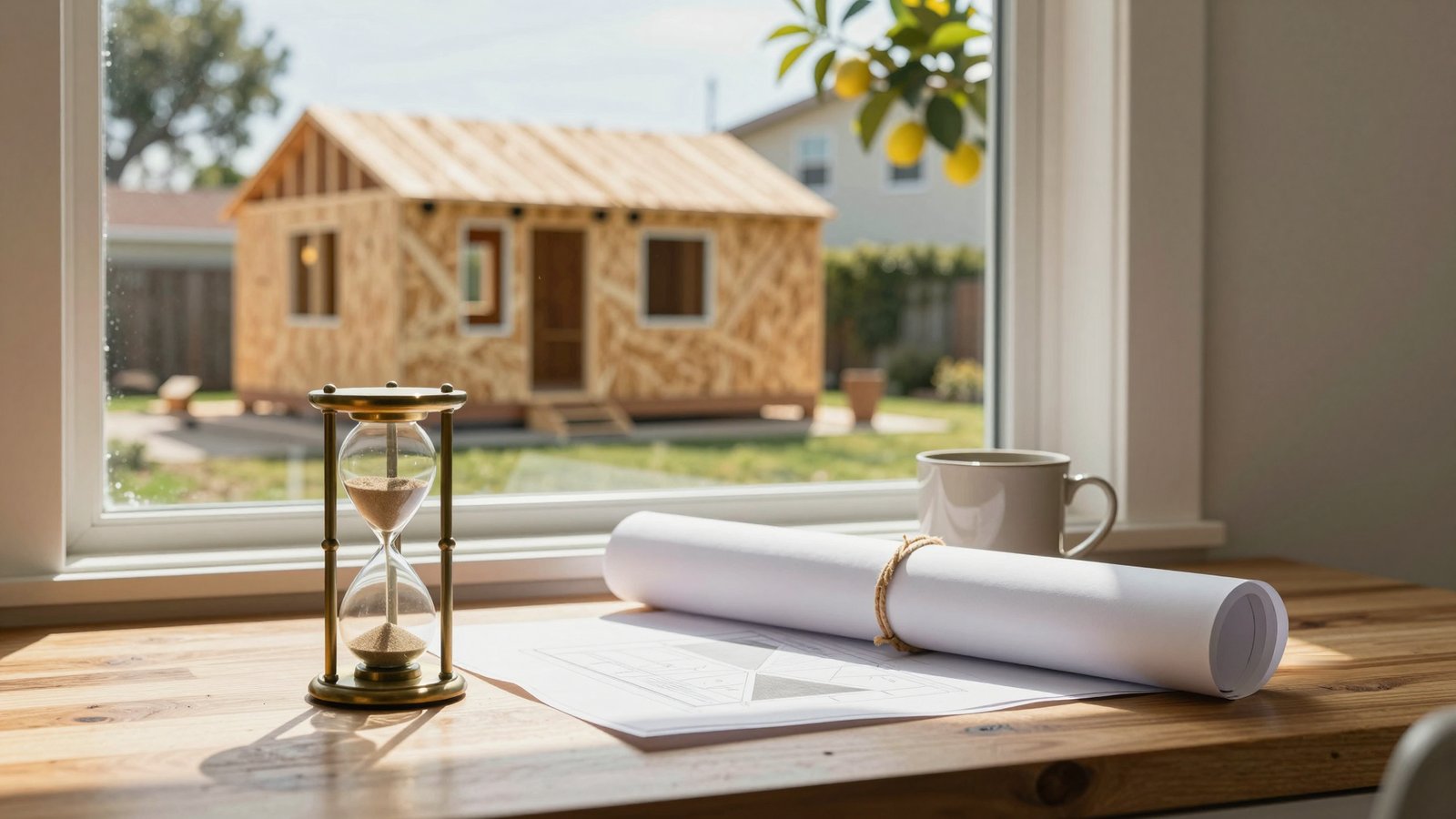
Why the Clock Matters
Waiting on the permit is often the slowest part of adding an ADU, and state law addresses that directly. An ADU permit application must be "considered and approved ministerially without discretionary review or a hearing," and the law puts deadlines on both halves of the review: deciding whether your application is complete, and deciding whether to approve or deny it.
A note on section numbers
SB 477, effective March 25, 2024, moved California's ADU statutes out of Government Code Sections 65852.2, 65852.22 and related sections and into a new chapter, Sections 66310–66342. The shot clock now lives in Section 66317, with parallel rules for junior ADUs in Section 66335.
Step One: 15 Business Days to Rule on Completeness
SB 543 (Chapter 520, Statutes of 2025), effective January 1, 2026, added a completeness deadline. Under Gov. Code Section 66317(a)(2):
- The permitting agency must decide whether your application is complete and tell you in writing within 15 business days of receiving it.
- If it's incomplete, the notice must include a list of incomplete items and a description of how to make the application complete.
- When you resubmit, the agency cannot require an item that wasn't on that list. The resubmittal gets its own 15-business-day review.
- If the agency misses the deadline, the application is deemed complete.
"Permitting agency" is broader than the building counter. State law defines it as any entity involved in reviewing an ADU permit for which there is no substitute, including planning and building departments, utilities, and special districts (Gov. Code Section 66313(k)).
Step Two: 60 Days to Approve or Deny
Once the agency receives a complete application, it must approve or deny it within 60 days if there is an existing single-family or multifamily dwelling on the lot (Gov. Code Section 66317(a)(3)). If it hasn't acted in that time, the application is deemed approved, a remedy added by AB 3182 in 2020. Unlike the completeness and appeal deadlines, this one is not stated in business days.
A denial carries its own obligation. Within the same window, the agency must return a full set of written comments listing every defective or deficient item and how to fix it (Gov. Code Section 66317(b)). According to HCD, a full set means comments from every reviewer at every permitting agency, and the 60-day countdown keeps running until that complete list is delivered. HCD also says a new application after a denial starts a fresh 60 days.
What pauses or changes the clock
- Your own request for a delay. If you ask for more time, the 60 days is tolled for the length of the delay.
- A new primary home in the same submittal. If the ADU is submitted together with a permit for a new house or multifamily building, the agency may hold the ADU decision until it decides on the new dwelling. The ADU still gets no discretionary review or hearing.
- The coastal zone. A coastal development permit for an ADU follows the Section 66317 process: the local government must approve or deny it within 60 days of a completed application, without a required public hearing, at the same time as the ADU application. Where there is no certified local coastal program, the Coastal Commission decides on the same timeline (Gov. Code Section 66329, as amended effective October 10, 2025).
No local ordinance, policy, or regulation other than an ADU ordinance consistent with state law can be the basis for delaying or denying the permit (Gov. Code Section 66317(c)). And if you're replacing a detached garage with an ADU, the demolition permit must be reviewed with the ADU application and issued at the same time (Gov. Code Section 66314(e)), so include it in the same submittal.
Pre-Approved Plans: A 30-Day Path for Detached ADUs
AB 1332 (Chapter 759, Statutes of 2023) added Government Code Section 65852.27, which required every city and county to set up a program for pre-approving ADU plans by January 1, 2025. Under that program:
- The agency can't restrict who submits ADU plans for pre-approval, and it may charge the same permit fees it would charge for an ADU of the same size.
- Pre-approved plans are posted on the agency's website along with the applicant's contact information.
- Agencies may also admit plans they developed themselves or plans pre-approved by other agencies in California.
An application for a detached ADU must be approved or denied within 30 days of a completed application if it uses a plan the agency pre-approved, or a plan identical to one used in a detached ADU application the agency already approved, in both cases within the current triennial California Building Standards Code cycle. Two caveats: Section 65852.27 doesn't spell out a separate deemed-approved remedy for the 30-day deadline, and the application is still reviewed ministerially under Sections 66317 and 66320, so your lot still has to meet objective standards.
Practical Tips for Homeowners
- Submit against the agency's own checklist. Get the current ADU submittal requirements from your city or county, and from the water, sewer, and fire districts that serve your lot, before you file.
- Document the dates. The 15-business-day completeness clock runs from the day the agency receives your application; the 60-day clock runs from the day it receives a complete one. Keep a date-stamped receipt for every submittal and calendar both deadlines.
- Treat the incomplete list as the whole list. Answer every item in one resubmittal. The agency can't add new items at that stage.
- Be deliberate about delays. A delay you request pauses the 60-day clock, so avoid open-ended extensions and get any delay's length in writing.
- Check for a pre-approved or previously approved plan. For a detached ADU, a design already approved in the current code cycle is the fastest path the statute offers.
- Know your escalation options. Agencies must provide a written appeal process for incompleteness determinations and denials, with a final written decision within 60 business days of receiving the appeal (Gov. Code Section 66317(d)). HCD, which has had authority to enforce state ADU law since January 1, 2024, takes technical-assistance requests through its ADU Portal. HCD asks applicants to use the agency's process first and may not follow up without a pending application.
If a deadline passes, raise it with the agency in writing before relying on a deemed approval to start work, and consider getting legal advice. Per HCD, you will still need a certificate of occupancy before anyone moves in.
Key Takeaway
California's ADU shot clock is real, but it rewards applicants who file clean, complete packages and track the dates.
nanohouz handles permit research and processing for the ADUs we build. Permit fees are not included in our prices; they are paid to the city and other agencies. Tell us about your project and we'll start with a feasibility review of your site.
Sources
- California Government Code Section 66317 (as amended by SB 543, effective January 1, 2026)
- California Government Code Section 66335 (junior ADUs)
- California Government Code Section 66313 (definitions)
- California Government Code Section 66314 (garage demolition permits)
- California Government Code Section 66329 (coastal zone)
- California Government Code Section 65852.27 (pre-approved ADU plans)
- California Department of Housing and Community Development, Accessory Dwelling Unit Handbook (March 2026)
- California Department of Housing and Community Development, Accessory Dwelling Units
This article is general information, not legal advice. It reflects state law as of September 2026; ADU law changes often and local procedures vary, so confirm current requirements with your permitting agency.
Keep reading
ADU Impact Fees in California: The 750-Square-Foot Line and What Cities Can Charge
California bars impact fees on ADUs with 750 sq ft or less of interior livable space and limits them above that. How proportional fees scale, what school and utility fees apply, and how to budget.
Renting Your ADU or JADU in California: Owner-Occupancy Rules and the 30-Day Minimum
California bars owner-occupancy rules for ADUs, and since 2026 only JADUs that share a bathroom require the owner on site. Here's how the 30-day rental minimum shapes short-term rental plans.
Manufactured ADU Costs in California: What the Starting Price Covers
Every nanohouz floor plan now shows a starting price. Here's what it covers, what our turnkey scope includes, and the lot-specific fees, site work and utility costs that move a California ADU's final number.